
The Dana family has been making pure Vermont maple syrup for five generations, on the same farm.
After the passing of Alden Dana, his great-niece Chelsea purchased the farm from his family in order for her and her father, Rick, to continue doing what they love- making maple syrup. Rick has been sugaring on the land his entire life next to his father and Uncle Alden. Living just two houses down from the farm, he knows the land like the back of his hand. Chelsea continued in her father's foot steps when she was child- helping out with tapping and labeling bottles for Alden in the sugarhouse basement.
Along with Chelsea's husband, Joel, and brother, Cody Dana, they have tirelessly worked to maintain the quality Vermont maple syrup they have been known for, while also adapting to the ever-changing maple industry.
Although sugaring takes up much of his time these days, Rick also works in landscaping and small excavation. Chelsea is a stay at home mom for her and Joel's three young children. Joel is a career firefighter/paramedic for the City of Lebanon, and a flight medic for the NH National Guard. Cody is a mortgage loan officer for Mascoma Bank, and he mostly handles all of Dana Bros. social media presence.

We have about 2,000 taps on 130 acres that we collect and boil daily to maintain a high quality sap.
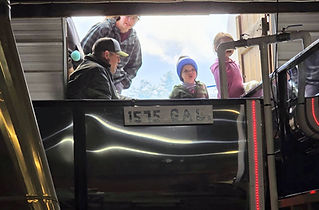
The sap from our road-side tanks are brought to our sugarhouse tank where it is then fed by gravity into our wood-fired evaporator.

Did you know it takes about 40 gallons of sap to make one gallon of maple syrup? We just upgraded our 1970s Leader evaporator for a more efficient model (still wood-fired!) This cut down on the amount of wood needed to run by more than 50%.


Sap becomes syrup when it reaches 219 degrees fahrenheit. Once it reaches 219, a hydrometer is used to ensure it is the correct density. Because our operation relies on gravity, our canning area is located in the basement of the sugar house. Once the correct density is acquired, the sap is released through a valve, to the filter press down stairs.
When sap is boiled down, the minerals that are naturally found in maple sap concentrate and form niter, or "sugar sand." Filtering out the niter improves color, clarity, and taste of the finished maple syrup. We use a a filter press to do this, which then pumps the final product into a water-jacketed canner. The canner allows us to control the temperature of the syrup to ensure safe canning practices.